Enjoying a Career in the Middle 

I published my most viewed blog, Lessons Learned from a Lifetime in Business, almost exactly two years ago.  It was a list of simple lessons I learned along the way from my father, from leaders I admired and from my own experiences along the way.  They were pretty basic lessons, at least basic and simple to state … much harder to live out daily.  (https://thoughtsfromthemiddle.net/2017/01/23/blog-post-title-2/)

Almost as soon as I posted the blog, I felt I could push a little deeper, but wondered what my unique perspective was that would be any different than any other leadership blog or book out there.  It occurred to me that most leadership advice is positioned from a top down perspective.  In other words, what should those select few, who lead organizations, do as leaders to drive performance, or build culture?  However, I have never led a company.  I’ve led teams within large organizations.  I’ve led myself.  I’ve led cross functional project teams, and, I have contributed to teams my entire career.

So, this blog is intended for people like me, who will spend a lifetime in the middle, or maybe “upper middle.”  I haven’t read many articles targeted at this group, even though that’s the vast majority of people having long careers in the corporate world.  You race to the middle in your early years, and then move laterally through the enterprise for your mid and late years.  How do you stay excited?  How do you continue to learn and contribute?  Here is my advice for enjoying a career in the middle.

Delegate EVERYTHING!

Admittedly, I’m trying to grab your attention early.  Obviously, you can’t delegate your entire job.  However, delegate as much as possible, and delegate projects of value!  The reason for delegating, however, evolved for me over the years.

I think there is a natural tendency for new managers to not delegate much at all.  They either feel uncomfortable with the act of delegation because they are new to it, or they are still in the mindset of proving their worth by doing the work themselves.  It took me some time to get comfortable delegating.  Then, there were times early in my career as a manager, I delegated just to test the waters and see what it was like, and, in all candor, to see what I could get away with.  I mean, let’s take these manager wheels out for a drive, you know?!  There were times in the middle of my career when I found myself delegating just because I could, and I was looking for some relief.  None of those motivations sound very inspiring, do they?  They are not! They also do nothing to help you in your career or to help your company.

You should delegate as much as possible for the benefit of your team.  In my experience, delegating projects to your team builds confidence, capabilities, engagement and quality of output.  Let’s look at each one.

Delegation builds confidence.  While you may not volunteer this outwardly, getting projects given to you by your boss makes you feel valued.  As a manager, however, you have to handle this properly.  Don’t give away work that has no value.  Do the opposite!  Delegate work of great value.  Empower your team and let them shine!  When individuals are allowed to do work of value, and contribute to the success of the organization, they will grow in confidence and the output of each subsequent project will improve.  Everyone improves with this approach.

  • Delegate everything … Not to diffuse work, but to build team capability, engagement and quality output

Delegation builds capability.  Think about a time when you literally felt yourself learning.  It was likely uncomfortable.  It was likely a little bit scary.  And it was likely a pretty great feeling!  You learn when you are stretching your abilities, and you do that when you are challenged.  Providing your team opportunities to stretch is one of the key benefits of proper delegation.

Delegation builds engagement.  I’ve often discussed the value of the team triangle … performance, enjoyment and learning.  All three must be in equilibrium in order for a team to be operating at the highest level.  Providing your team with relevant and high value work can help in all three areas.  This is one of the key benefits of delegation.

And finally, delegation improves output.  If you frequently delegate high value work, your team will adapt and begin to generate better and better work.  They will feel empowered, and trusted, and they will feel a sense of obligation to produce great work.  Why?  Simply put, because they want to deliver for you and for the organization.  When someone puts trust in you, most people want to deliver greatness to prove worthy of that trust.  You’ll learn quickly if that motivation isn’t developed in a person.  At that moment, you’ll know what you need to do!

Everyone can teach, so ask them to!  

I was attending a leadership seminar at a college once.  It was a fairly small group in attendance.  A professor was leading the seminar, and he opened up the day in a very strange way.  He asked each person to stand up and teach a brief lesson to everyone else in the room.  This was not a homework assignment.  There was no warning or disclosure in the pre-read.  He just sprung it on us!  Teach us something!

I mean … what the hell?  What can I teach this group?  I didn’t prepare anything.  I have no PowerPoint slides or handouts!   And, amazingly, I didn’t need anything.

When it came my turn, I pulled out a relatively simple acronym I had learned in a selling class early in my career that provided a way of overcoming objections from buyers.  The acronym was LAER.  Listen – Acknowledge – Explore – Respond. (1)  I don’t know why that one part of that sales class stuck with me so, but it did.  And it’s worked pretty well for me over the years.  But that’s not really the point here!

The point is, that I had learned something along the way that I was able to teach to several of my peers on the spot!   While it was unsettling to have it sprung on me that morning in the seminar, it was impactful to me that everyone there had these little lessons that they were able to retrieve and share with others.  That’s when it occurred to me … Everyone can teach, so ask them to!

  • Build team unity by having your team teach one another.

I frequently start my staff meetings with what I now call “Leadership Energizers”.   I assign a person to start the meeting with a brief (max 5 minutes) lesson they would like to share with the team.  It can be an inspirational video they’ve seen, or an article they read.  It could be something they learned from a parent, or coach, or previous leader.  It can be business related or it can be personal.   One young lady on my team once shared some advice she was given once to never order anything at a restaurant that you can make at home.  I loved that, and it stuck with me.  I try to live by that and it’s made eating out infinitely more fun!

Everyone can learn from everyone on the team.  And THAT is the point.  Everyone can contribute.  There is no hierarchy or corporate structure to learning.

Trust in the genius of your team

This past year, my team had a terrific year.  We exceeded our business plan targets on all metrics and were one of the top producing teams in the company.  It was, by all counts, a terrific year!  Unfortunately, the business environment was challenging, and our full division, while growing and winning in the marketplace, fell short of our company’s high expectations.  This happens at times.  Extraordinary events can put stress on the best laid plans.  While I feel great about how my team performed, it’s a bit of a Pyrrhic victory when the division, as a whole, fell short.

In all honesty, I’m a little disappointed in our senior leadership.  The shortfall was predicted early in the year, but our individual team plans were not adjusted.  In my opinion, the time when things are the most challenging is the exact time to engage the genius of the broader organization.  We should have re-planned the year and allocated incremental plan goals to each team.  It would have been frustrating and stressful for sure.  Individual teams like ours might have fallen short of their new, more aggressive goals.  I know, however, that we would have finished the year as a division stronger with a re-plan than where we did with our status quo approach.

  • Engage your team when problems are the most complex

You need to trust in the genius of your team.  Challenging problems should not be solved by the elite few.  They should be solved by the collective whole.  Your team will learn.  They will gain insight into the business, and will become stronger leaders themselves, which will lead to greater results for years to come.

Build and spread culture by telling stories

In 2004, E. Neville Isdell, a long-time international leader in The Coca-Cola System, was coaxed out of retirement to lead The Coca-Cola Company as Chairman and CEO.  The company was in transition coming off a first major restructuring, and significant leadership turnover.  In his first address to our U.S. leadership, Isdell challenged us to create and spread the Coke culture by telling stories.

I remember liking the sentiment as he said it yet being unclear as to what exactly he meant and how it would work.  For starters, “what exactly was the Coca-Cola culture?”  Right behind that question lingered, “what stories am I supposed to share?”

As I progressed through my career as a leader, my feeling on this area of advice has evolved significantly.  Let me address the two questions I posited earlier.  First, what was the company’s culture?  For years, we as an organization have espoused leadership behaviors and growth behaviors that we believe in.  There is value in this as it creates opportunities for us to discuss the meaning of those values.  What does “Drives Innovation” mean, or “Act Like an Owner?”  The value comes in the discussion, not the words, and the easiest way to bring the values to life is by sharing examples of when the words were realized. … telling a story about a person or team that positively drove innovation in process or product, for example.  It occurred to me over time that the culture of the company varied completely by the team you were on, and who your leader was.  The examples each leader shared varied, or the extent to which they shared stories at all varied.  My conclusion, then, is that the culture of the company is an aggregation of the micro-cultures created by each team leader.  When you realize this, you also quickly realize the critical role team leaders play in the company.  Effective leadership training combined with strong recruiting become absolute necessities to create the culture you want in a large organization.  Great doers do not necessarily make great leaders.  Find the effective story tellers and teachers in your organization, and your culture will benefit.

As for what stories are appropriate to share, I think the answer is to use stories that best demonstrate how you see effective teams operating.  You can do this by sharing stories of work in the past that match your image of great teams.  You can also do this by sharing examples of poor performing teams as opposites to emphasize the desired team approach.  You have to use stories, however, that you have a connection to and that you personally believe.  To do otherwise will be seen as disingenuous.

To figure out how often to use stories to build culture, think about it as a school teacher.  If a teacher only stood in front of a class and told stories, kids might enjoy the class, but they wouldn’t get much done and wouldn’t learn enough to move on to the next grade.  Missing from a story-telling only curriculum is practice, discussion, application, debate, group projects and other proven methods of learning.  Stories should be used for impact, and when other methods are not as effective for sharing ideas.

It’s Not About You!

So, this one is a bit controversial, yet it may well be the primary reason why I’ve spent a long, and successful, career in the middle!  You see, when I sincerely contemplate my personality and my belief system, making things not about me is directly at the core of who I am as a person.  I fervently believe this specific advice to be a key to fulfillment in a career in the middle!  It’s not about you.  It’s about the company, or the team, or the enterprise.

Growing up, my father always had a plaque on his desk that said: “There is no limit to what a man can do or where he can go if he doesn’t mind who gets the credit.”  I didn’t know the origin of the quote, but he didn’t just set the words on his desk.  He taught this to me, in how he carried himself, and in how he coached me through life.  It turns out the quote was from a plaque on Robert Woodruff’s desk.  Robert Woodruff was the legendary CEO of The Coca-Cola Company from the 1920’s through the 1950’s, and my father looked up to him.  Later on, Ronald Reagan would take ownership of this same quote, and carry the same plaque on his desk.  The actual origin of the quote is much muddier and significantly deeper in history.  And yet, those words have been with me almost my entire life.  I have a coffee mug on my desk to this day with the same quote on it (a plaque is definitely classier, but hey, that’s me!).

woodruff

There are scores of books and articles on humility in leadership, and on servant leadership.  I’m not going to try to create a new one here.  Finding joy and meaning in making the whole better, though, is likely the biggest key to finding satisfaction in a career in the middle.  Taking action against process improvement, for example, or in doing the little things and helping out no matter how small the task is meaningful to the organization and to the team as a whole.  They are not the things that people brag about in interviews, or write out on resumes, but they matter so much.   I often stay after to clean out a conference room of trash, or to help people carry things back to their desks.  I like to get to meetings early to make sure all of the a/v equipment is functioning.  Sexy stuff, huh!?  It makes others enjoy their days more, however, and it makes the meetings more productive.  More productive and happier people do better work, and we get stronger as an organization.

  • A strong career is built by making the company look and perform better, not by focusing on making yourself look and perform better.

You will read more books and articles on the necessity of establishing your leadership voice, and on defining your brand.  You will find many more videos about the need to stand out and make your own path.  There is absolutely a need for all of that.  In the end, however, estimates are that only 1.5% of people over the age of 15 earn $200K or more per year.  How many people will become senior vice presidents, or presidents of companies?  A clear majority of people in the workplace will work in the middle!  You can choose to languish there and long for more day after day, or you can find joy and worth in helping the enterprise, and others around you, succeed. Choose your own attitude and find joy in the pursuit of team betterment.

Life in the Middle

Creating a successful career, and a happy life are not at opposition to one another, if you can find joy in both.  Consider the following quotes:

“For it is in giving that we receive.” – Saint Francis of Assisi

“The sole meaning of life is to serve humanity.”- Leo Tolstoy

“We make a living by what we get; we make a life by what we give.”- Winston Churchill

“The purpose of life is not to be happy. It is to be useful, to be honorable, to be compassionate, to have it make some difference that you have lived and lived well.” – Ralph Waldo Emerson

“The best way to find yourself is to lose yourself in the service of others.” – Mahatma Gandhi

“And, in the end, the love you take is equal to the love you make.” – Paul McCartney

Engage your team.  Trust them with valuable work.  Let them teach you and one another.  Build an amazing culture by sharing stories of worth, and make everything about the team.  Do these things and you can enjoy a career and a life in the middle!



(1) “You’ll Never Get No For An Answer”, Jack Carew, October 1, 1987, Simon & Schuster, Inc.

The Return to Safe Pride

This will be a companion piece to my first ever blog, The End of Safe Pride.   If you haven’t read it yet, click on the link.

I received and saw several comments that people liked my article, but kept wondering how we would get out of the space we’re in today.  That really is the million-dollar question, isn’t it?  Well, I would never claim to have the solution to that.  (I would selfishly claim the million dollars and fall off the grid if I did!)  I have been giving it some thought, however, and thought I would share how I’m going to try to get back to safe pride.

Action 1:  Quit isolating my inputs

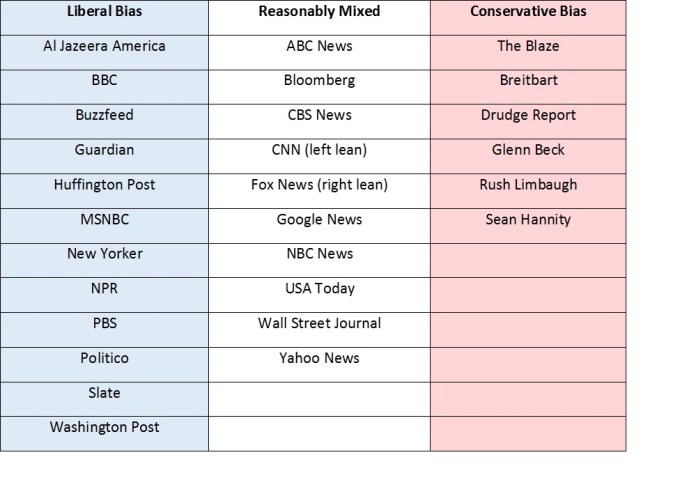
I need to balance my news sources and make sure I am forcing myself to hear both sides.  Here is a list of newsfeeds broken out by the ideological profiles of their audiences:

media-table

Source:  Pew Research Center, http://www.journalism.org/interactives/media-polarization/http://www.journalism.org/interactives/media-polarization/table/trust/

P.S.  Let’s not argue about the exact placement of each and every site, please!  Clearly Fox News has a conservative lean, but clearly CNN has a liberal lean.  At least they both provide some voice to both sides of ideology.   If you want to argue the placement of sites in the columns, you might be doing exactly what I’m going to suggest you change!

If I am reading or listening to content from the sites listed in the Liberal Bias or Conservative Bias columns, I am going to force myself to read an opposing view from the other column.  I will not allow myself to only hear what I want to hear.  That cycle raises my sensitivity to opposing perspectives.  I may not change my view, but I can’t allow myself to be angered when I read or hear it.  That’s known as a trigger!  Whenever I feel the tug at my gut when I am reading something … that tug that says “this is bullshit” … I am going to try to force myself to take action. So, for example, let’s say that a friend of mine posts another article that sucks me in to reading a scourging review on The Blaze about something somebody horrible said to someone’s momma.  My bullshit meter goes off.  I will look on Slate for a countering opinion.

I’m also working to eliminate as many of those biased sources from my feed as possible.  They still creep in when friends share them, but I’m not following them anymore.  The lack of balance from those sites are adding triggers, not providing safeties, to use a firearms analogy.

Let’s all work to balance our inputs, and quit relying on isolated perspectives.  Stephen Covey’s famous 5th Habit says “SEEK FIRST TO UNDERSTAND, THEN TO BE UNDERSTOOD”.  You can’t accomplish that if you don’t open up your perspective.

Action 2:  Use the sandwich rule

There is a feedback model that is sometimes shared in the business world to balance feedback you provide to associates.    I’ve heard it called the “Sandwich Rule” … praise followed by a suggestion on how to do your work differently, followed up with yet another praise.  You sandwich the feedback with complements to soften the message and ensure employees leave with strong self-esteem.   We can debate the effectiveness of this method at a later date, but I started thinking about the impact this could have if applied in social media.

Let’s use the same example of that article about something somebody horrible said to someone’s momma.  The posting of that article is accompanied by my friend’s lead stating “Bout time Momma got the beat down she deserved!  8 years of craptastic gobbledegook is enough!!!”  (anyone seen something like this from a friend on Facebook or Twitter?!?).    Most often, the responses to such a post fall in four categories:  1) Ignore and move on (possibly the most constructive); 2) Unfriend or Unfollow (the soft and polite unfriend!); 3) Aggressive Agreement – “Damn Skippy, dude!  Momma so deserved it!”; or, 4) Aggressive Dissent – “That is so ignorant.  Typical!  Momma so clearly said ‘Knock Him Out!’”  Any of those sound familiar?  What if instead we applied the Sandwich Rule to comment on the momma post?

Post: “Bout time Momma got the beat down she deserved!  8 years of craptastic gobbledegook is enough!!!”

Response:  PRAISE – “Thanks for sharing.  Interesting perspective” SUGGESTION – “I read another article that stated that Momma had actually nothing to do with this, so maybe this could have been avoided.  Here’s the link.”  PRAISE – “Thanks for sharing, AND thanks for listening.  I appreciate you.”

Okay, I know, that was cheesy as hell!  But isn’t it WAY better than what we’re seeing today?  How many of your friends have put out messages saying they’re going to stop following anyone who posts anything political, or more precisely, anyone who posts anything opposing their views?    I, for one, will take a little cheese over the big Yeti tumbler of Bitrex we’re being served up each day lately!

Action 3:  Listen More and Talk Less!

Have you ever heard the saying God gave you two ears and one mouth, so you should do twice as much listening as speaking?  It may have come from James 1:19, “Wherefore, my beloved brethren, let every man be swift to hear, slow to speak, slow to wrath.”

This idea is a nice add to Action 2 – The Sandwich Rule.  Before even considering responding, make sure you are listening well.  Use empathetic listening by trying to hear the message through their ears, and see the message through your friend’s eyes.  There are some great books and articles about listening.  Most address the bias that we all listen through.  We listen, primarily, with the intent to respond.  So, we immediately begin to craft our response.  That’s why we drift off while we “listen” to people.  We begin to think about how clever a response we will make or exactly how we’re going to zing the other person.  If I say this, they’ll really be impressed!   The author, David Augsburger, has a great quote: “Being heard is so close to being loved that for the average person, they are almost indistinguishable.”

So, the action should probably be amended to read, listen more, talk less and, therefore, LOVE!

Action 4:  2 for 1

This one will be hard for me, but I’m going to give it a try!  I’m going to start using a 2 for 1 approach to posting.  For every post that I make that is argumentative, political or accusatory, I must post TWO posts that are meant to be loving, uplifting, encouraging, or inspiring.  I might amend the name of this action to the 1 Link/2 Puppies Rule!  If we all follow this formula, we will gradually change the balance of power in social media.  Today, we all cringe just a bit when we open our feeds.  Recent polls show that people are wanting to spend less time on social media because they don’t like the tone … too political!  Well, let’s do something about it.


I recently shared an article that was posted on Cincinnati.com by Pastor Kevin S. Aldridge  (http://www.cincinnati.com/story/opinion/contributors/2017/01/23/s-not-trump-s-us/96942316/)  It’s a really well-written article that discusses the topic of this blog directly.  In one of my favorite lines in the article, Pastor Aldridge says, “We absolutely should stand up and speak in favor of our beliefs, but we don’t have to say something about everything. And when we do open our mouths, we should endeavor to be thoughtful and solution-oriented. It’s easy to finger-point and highlight flaws.”

Another friend of mine shared the irony of the snarky back and forth that occurred in the comments section of that very article.  So, I fully expect there will be some snarky comments to this article.   And that’s fine.  Snark away.

But here’s my ask.  Try to be more open to other sides of the issues.  Give praise to others while telling them your ideas.  Listen more closely to one another.  And fill the social space with more positivity than negativity, in at least a two for one ratio!  If you do that, I’ll take a few snarky comments!

Thoughts from the Middle

Well, I’m not sure I is smart enough to blog, but I am willing to learn. Thoughts from the Middle is essentially going to be ramblings related to things that make me go, “hmmm.”  I’m not always good about catching the fleeting thoughts, and my brain isn’t wired to work through thoughts sequentially, so the thoughts that make it to this blog will likely be random in order and approach.  I will try to stay light and productive, but can’t commit that there will not be an occasional rant.  I will try to stay original, but, really, most of the truly original thoughts have been explored.  I should say that I will try to take an original track to the exploration.

Let me know what you think!

The End of Safe Pride

I am 53 years old.  That means my hair is thinning, I’m having a hard time maintaining energy to work out and keep weight off, I’m losing my hearing, and I’m starting to forget things way too easily.  I’m also starting to forget things way too easily (if you’ll recognize that my repetition there was intentional and meant to be funny the rest of this diatribe will be much easier for both of us!).

Being 53 also means that the 1984 Presidential Election between Ronald Reagan and Walter Mondale was the first presidential election I was old enough to participate in by voting.  I did vote, and I’ve voted in every election since.

I remember voting with pride for Ronald Reagan, and sharing my vote with pride with my friends, because Reagan won in a landslide (525 Electoral Votes to Mondale’s 13!).  There weren’t a ton of Mondale supporters running around to find, so it was a very safe pride.  Republicans had won two elections in a row (this was Reagan’s second win) and would go on to win a third term when George Bush defeated Michael Dukakis in 1988.   The 1988 Election was the last time any candidate reached the 400 Electoral vote mark (426).  1988 also marked the first election since 1976 that New York voted Democrat.  That state has been solidly blue ever since.

Bill Clinton would win in 1992 with 370 Electoral votes versus Bush’s 168.   California voted Democrat in 1992, and has been solidly blue ever since.

Why does any of this matter?

It matters because the end of safe pride started in 1992.

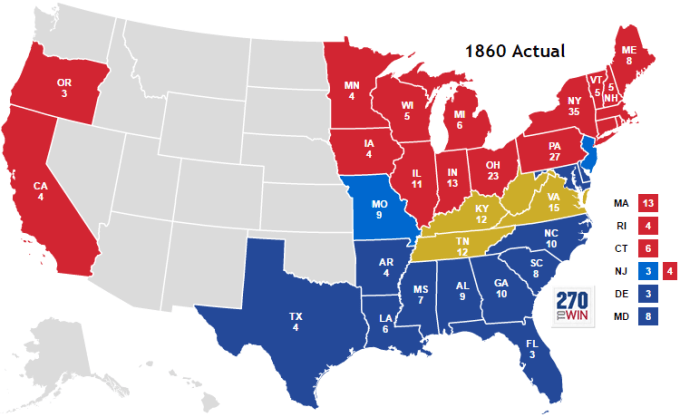
We are a divided country, politically, and until a dramatic cultural and demographic shift impacts another populous state like New York and California (are you listening Texas and Florida) then, we will continue to be such a divided country.  And therefore, it matters because if we don’t learn to live together in this politically divided country, we will become more than just politically divided.   None of us were around in 1860, the last election before the Civil War.  But take a look at this Electoral Map:

1860-electoral-map

1860-electoral-key

Isn’t it weird to see such big blocks of states so divided ideologically?  Hold that thought.

Why do I say the end of safe pride?  I remember the 1992 election.  I was now out of college, and more attuned to national politics.  I actually watched the news.  And for the first time in my life, I became much more aware of other political views.  My oldest brother, it turns out, is a Democrat (gasp!).  And apparently a pretty active one!  And, he’s pretty damn smart!  And, I actually like him.  But, he’s a Democrat!   It also turns out that a lot of my high school and college friends are Democrats.  And pretty active ones.  And pretty smart.   And, I actually like them.  But I grew up in a safer environment with my brother, my high school, and college friends.

You see, back in my day, we didn’t have these fantastical, portable computing devices!  But that’s right around when they started to appear.    The World Wide Web was created around 1990, and the first web browser showed up a little while after the 1992 election (anyone remember CompuServ?).  And that’s how it began.

Suddenly it became about immediacy.  It wasn’t good enough to wait for the 6 o’clock news.  People became empowered when they had news first.  I was somehow just a little bit better than you if I knew things before you.  1992 also featured the introduction of the Headline News SportsTicker on CNN.  MSNBC and Fox News came along in 1996, and, of course, September 11, 2001, brought on the need for true 24-hour news and the permanent news ticker on almost every news station.  Out of the information boom that was the web was born a faster, yet more, fractured news cycle.

And right in the middle of this new, information boom, came the 2000 election, where George W. Bush won the national electoral college vote by 5 votes, while the national popular vote totals favored Al Gore by only 540,000 votes … the very definition of divided … right down the middle.  By this time, if I proudly shared my vote, there was a very good chance the person I was sharing with had voted opposite me.  Stories about how this candidate had done something terrible to someone else had been quickly spread across the nation, so not only did you hear that your vote was wrong, the repudiation was accompanied by a news story that you might not have heard yet.  It was so important to keep up!

Tuesday, September 11th, 2001.  The country was rocked by a horrific attack.  The horror led to a national sense of outrage, yet pride and patriotism.  Honestly, when I think back on that day and the days that followed, our petty squabbles today seem so, well, petty.

Following 9/11, we faced a confusing set of decisions on who these new enemies were, and how we should fight them.  We were launched into a series of confusing wars, with devastating consequences.  And the new, 24-hour news cycle, which had new shows dedicated to exploring both sides of all issues, forced you to choose those sides.

George W. Bush guided the nation through those dark days, but the nation grew weary and suspicious of the wars and its true motives, and a financial collapse driven by a selfish financial sectors’ opportunistic and usurious methods led to a historic political shift.  In 2008, Barrack Obama was elected president with the largest margin of victory since Bill Clinton’s re-election in 1996.  Obama was our first African American President.  He was also the 5th youngest president in U.S. history, and was much more in tune with more modern trends, technology, music, fashion AND social media.

Social Media?  The term that dominates so much of our lives today wasn’t really a thing at the time of the September 11 attacks.  But by the end of Bush’s second term, we had entirely new social structures like SixDegrees, MySpace, and Friendster.  And, we had the now ubiquitous Facebook, started in 2004, and Twitter, started in 2006.  Isn’t it hard to imagine?  These communities, these definers of culture, these dispensers of news, these indispensable appendages to us all, are barely 10 years old.

Social Media?  Is it meant to be social, or is it meant to be media?  My personal experience with the new Facebook was social, as it was an amazing tool to reconnect with long lost friends and quickly discover what was going on in their lives, and share updates on my life experiences.  My personal experience with the new Twitter was media.  I used it primarily to follow news headlines and get quick, easy updates.  The device that made it all blur together, however, came to us in 2007.  The amazing power and sexy design of the iPhone changed the world.  Now, all of the benefits of the world-wide web, combined with the network created by social media, was mobile.  It was everywhere, all the time, and ready to report the important, the life changing AND the mundane AND the silly AND the absurd.

Suddenly, as if overnight, getting things first was no longer good enough.  Suddenly, getting things LIKED became important.  Suddenly, getting FOLLOWERS became important.  The line between social and media and NEWS began to blur horribly.  New entrants to the world of “news” came on the scene …

  • Slate 2004
  • Huffington Post 2005
  • Breitbart 2007
  • The Blaze 2011
  • Occupy Democrats 2012

Our self-esteem, and our sense of import became driven by how many people followed us, liked our comments, retweeted our tweets, or shared our comments.  Did my selfies get a good reaction?  Were my food shots cool?  Were my sunsets gorgeous and jealousy inducing, and were my views reinforced by others?

There it is, really.  That last one.  Suddenly, I had the ultimate filter.  I could unfollow or unlike those whose views were different, and only follow those that shared my ideals.  Why should we deal with THOSE people … that basket of deplorables, or those whiny snowflakes.  As I made my filter choices, my exposure to other ideas lessened, and my sensitivity to those same ideas increased.  I didn’t want to hear them, and when I did, I became incensed!  Why couldn’t they see what I saw??

And into that setting, and into that powder keg of ideology stepped Hillary Clinton and Donald Trump.  Hillary represented everything that many conservatives despised … big, corrupt government, more taxes and more restrictions on personal choice.  Donald Trump was horrifying to liberals … divisive, vulgar and wanting to dismantle large government programs like healthcare.

We were so sensitive that we could never get to debate.  We watched what were called debates, but there was none.  The definition of debate is a formal discussion on a particular topic in a public meeting or legislative assembly, in which opposing arguments are put forward.  I don’t remember seeing anything looking formal, and certainly didn’t hear arguments, at least not being put forward.  I heard insults and rants.  Why did these two act that way?  Because it drove likes and shares and retweets and followers, and that drives self-esteem … even for politicians.

Who felt safe sharing their vote after this election?  Did anyone share their vote on social media and NOT get a vociferous response from someone who voted for the other side?  Here are some actual quotes that appeared on my wall:

“Trump supporters don’t seem to have a moral gauge at all” (really?  NONE of them?!?)

“Liberalism – there is only one solution for it – Euthanasia.” (seriously?!?)

And that leads to our electoral map of 2016.

2016-electoral-map

2016-electoral-key

Isn’t it weird to see such big blocks of states so divided ideologically?

Before any group claims absolute victory … “Trump won 3000 counties to Clinton’s 450”, or “Clinton won the popular vote by over 2.5 million votes” … there are a couple of sobering facts for both sides to consider.  Less than 30 percent of eligible voters actually voted for Trump, or Clinton, and more people chose NOT to vote than to vote for either one, by a margin of over 29 million!  That’s the ultimate “None of the Above” vote.  So NO ONE has the moral high ground here!

Do I believe we’re heading toward a Civil War?  I do not, and I certainly pray that we’re not, yet friends of mine (at least “Facebook friends”) were actually suggesting that a California Brexit (#CalExit) would be the best solution.  Surely, that would be better for citizens of their state than having to suffer through the tragedy of having a bombastic Republican president leading the Federal Government of a United States of America that they are a part of.  They will simply unfollow and unlike America, at least the “Red” states.

I honestly do believe it’s possible, however, that our United States could fracture, if we do not regain the ability for safe pride.  I must be able to share my beliefs, with pride, and not get attacked for simply having them.  If you share a countering view with civility and logic, I may well be persuaded.  If you tell me I should be euthanized because I have a belief, I’m a little less likely to want to talk to you!  I’d rather get my group of like-minded friends together and leave the union.  We’ve been there before folks, and it didn’t go well … 620,000 Americans lost their lives.

I’d like to not have to question news sources because I need to know their political leanings before I can trust the facts of the story.  This week we learned of the term “alternative facts” and people laughed at the craziness of the term.  Alternative facts are not facts, decried Chuck Todd!  Well, in our divided world of social media, that’s exactly what we get.  The facts are indeed alternated to fit the desired narrative.

I would like a different ending.  I’d like to get back to dialog, and back to debate.  Maybe it will happen.  I pray that it will happen.

Most of you know that I work for The Coca-Cola Company.  I have for 28 years, so it’s not like I’ve been hiding it!  Anyway, maybe we could agree on this beautiful sentiment, originally put forth by my company over 45 years ago …

I’d like to buy the world a home and furnish it with love,

Grow apple trees and honey bees, and snow white turtle doves.

I’d like to teach the world to sing in perfect harmony,

I’d like to buy the world a Coke and keep it company.


NOTE:  Maps sourced from 270towin.com

Lessons Learned from a Lifetime in Business

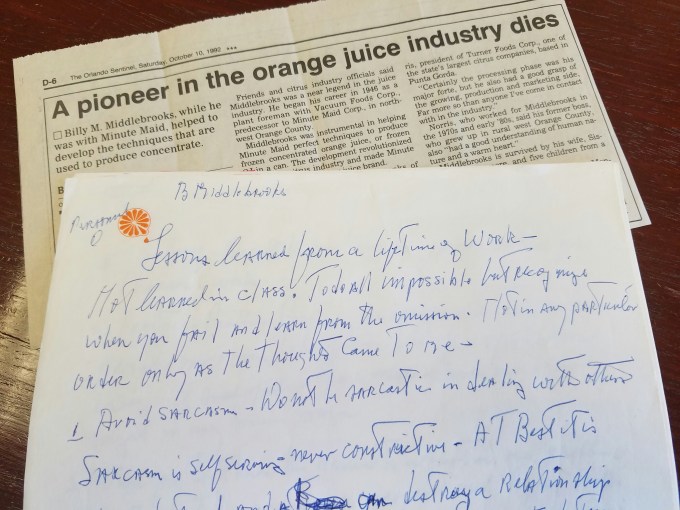
My father passed away in 1992. He was a very successful leader and had a tremendous 38 year career with The Minute Maid Company. While going through his desk after his passing, I found some notes titled “Lessons Learned from a Lifetime of Work.” It turns out he was preparing to speak at Rollins College and I had stumbled upon his written thoughts.

20170223_124636

Fast forward 25 years, and I decided to create my own set of lessons I’ve learned along my path in the business world. Some were shared with me from my father, and some were formed directly from his very hard to read notes! Some of these lessons I learned from other leaders and mentors, while some were simply acquired the old-fashioned way … by having them beat upside my head!

These are not presented from least important to most important. They’re not even in order of when I’ve learned them. They are purely provided for your reading enjoyment in the order they popped into my head. In the description of this blog, I warned you about my non-sequential brain!

Here beginneth the lessons …

Lesson 1: Avoid “They”

Never say, “They Said.” Do not pass off responsibility for decisions on some other faceless entity. As a manager and leader, the company position is your position. Never say, “They said ….” The faceless “They” is ever-present in most companies. At Coca-Cola, people love to say, “Atlanta said”, or “Leadership said.” I’ve always found this approach weak and a cop-out when leaders do it.

  • If you cannot be the executor and supporter of the decisions of your company, you should get out. As a manager, you are in charge, and when it is necessary to pass through instructions or policies, it should be clear that these are your policies and that you fully support the action requested.

Direction should be provided as “Here is what we need to do” or “Our policies are …” That certainly doesn’t mean that every directive that comes down from above must be blindly accepted and passed down. Debate and challenge if appropriate. Raise your voice and share your feelings on issues, with YOUR manager or YOUR leadership. However, after that debate and period of challenge, if the company policies stands, you as a leader are responsible for communicating that policy. Do so with conviction and ownership. Passing off direction as really belonging to someone else, or the proverbial “they,” weakens your role with your associates and those who follow you.

If you rely on “they”, you truly are just the messenger. Be a leader.

Lesson 2: “Say so!”

  • If you don’t know the answer to a question, say so!

This is one of the most common mistakes I see people make. They are simply afraid to be seen by leaders as someone who doesn’t know the answer to a question. So, what do they do? They make shit up!

When you don’t know the answer to a question, say so. Get the answer, if appropriate, and report back. Giving an incorrect response will be recognized, and repetition will, in time, identify you as a person who cannot be trusted to be correct. Responsiveness and a bias for action will always win out as attributes over eloquent obfuscation. It may feel better to provide a learned and eloquent response signifying nothing, but over time getting things right prevails.

Lesson 3: “Never, ever, knowingly drop a ball!”

This might be my biggest pet peeve in business … the person who sees a problem developing, and lets it happen because it’s “not their job” to deal with it. Letting a negative event happen just because you don’t feel it’s your job to address it is the ultimate statement about a lack of commitment to the enterprise.

  • If there is a genuine need, fulfill that need even if it exists outside of your specified role.

  • THEN, figure out whose role should address that need going forward.

When you are a member of an organization, whether that be a family, a partnership or a corporation, you have an obligation to help that organization grow and flourish. You can’t uphold that obligation by letting bad things happen when you have the ability and opportunity to prevent the bad thing from happening to begin with.

Step up. Pick up the ball. Run with it. Pick your metaphor, but take action. Once the issue is resolved, work with the organization to fix the process so that the responsibility for future occurrences is clearly defined, and the risk of future occurrences is mitigated.

Lesson 4: “Do something about it!”

  • You choose your own attitude … every day! If you’re not feeling good about your work environment, or your job, do something about it!

This is a tough one for me and for so many people I know, but it is so critical for success, and, more importantly, enjoyment in the workplace. It is so easy to get down about your job, your place in the organization, and about life in general when things don’t go your way … when your boss calls you out because you missed a deadline or didn’t deliver against expectations; when a presentation isn’t received as well as you’d hoped and after you worked long hours on it; when you are passed over for a promotion, or you don’t even get a shot; when someone clearly not as experienced as you gets the job you were hoping for. Do any of those sound familiar?

When one of those, or dozens more, “downer” events hits us in the workplace, it is very easy to slip into a funk of mediocrity. Often, we don’t even realize we’re in that funk. We just back away a bit, or don’t quite bring our whole selves to the office each day. Hell, after 28 years with my company, there are days where I slip into the “don’t I deserve a day or two of partial effort?” mode.

The reality is, though, that the only person who can get you out of your funk is you. You choose your own attitude, every day. So when you feel that slip start – and you do feel the slip if you are being honest – then figure out what your trigger is to get back in the game. I am motivated by wanting to leave behind a positive impression on those I work with, so when I feel myself slipping, I think about how that version of myself will be perceived if I continue in that space. For others, it may be that they need to take on a project to change their perspective. Maybe you just need to take a personal day to get your head in the right place.

Whatever that method is for you, however, find it, use it, and remember it! I can promise you that you’ll need it again in the future. You’ll feel the slip creep in … the funk of forty thousand years! (song reference?) … and you will need to access your method to get back in the game.

Lesson 5: “Learn how to present”

  • The ability to present ideas is one of the most critical skills you can obtain. Practice it like you would any other important skill.

Have you ever seen the quote, “Everyone lives by selling something”? I think it’s Robert Louis Stevenson … or Mark Twain … but I think it’s Robert Louis Stevenson. I believe this quote is mostly true. At Coca-Cola we like to say, “you’re either selling Coke, or you’re helping someone sell Coke!”

What is true in this world is that you have to be able to communicate your thoughts and ideas to be heard. I guess in a perfect world, everyone would listen so perfectly and so without bias that the method of communication would not matter. The message would come through regardless of the medium. But that’s not the case. People hear through their own bias, their own noise, their own distractions and their own attempts to finish your sentences and guess where you’re going! (you know you do that too!)

Therefore, you need to learn how to present! Whether via slide shows and in front of groups, or via one on one discussions, you need to figure out a balance of your own personal style and a compelling narrative. One tried and true method is the ever popular “tell me what you’re going to tell me, tell me, and then tell me what you told me”, a.k.a. Introduction, Body, Conclusion. That’s a clever mnemonic device (and it actually does work) but what I’m really talking about is that you need to find your own approach. For some people, using humor is a terrible idea (don’t attempt unless you’re a professional). For others, clever anecdotes can be a great device to pull in the listener(s).

Style is less important that situational awareness. Learn to read the situation and the audience, and adapt. That means preparing, thinking about the motivations of your audience, and catering your message AND your style. It really is a balance.

Practice this skill with people you trust, and, importantly, people who will give you honest feedback. Nothing is more damaging that the trusty friend who tells you you’re awesome when in reality you suck! Learn how to present, and you’ll be more effective in everything you do.

Lesson 6: “Be on time”

We’re not exactly sure of the origin, but one of my best friends and a great leader in our organization uses the following expression: “Early is On Time, On Time is Late, and Late is Unacceptable!” I love this! It’s catchy, it’s easy to remember and it is 100 percent true. Whether in your personal life or at work, nothing communicates a lack of empathy and respect like showing up late. The harsh reality that most people resist, however, is, 90 percent of the time, if you are late, it’s because you didn’t care enough to be on time.

Here are the most common reasons for being late, and why I feel they are most often inadequate excuses:

  • My previous meeting ran late. This is a tough dilemma I admit. And it happens a LOT at my company. By staying late in the one meeting to BE late in the next, however, you are choosing to respect one party more than the other. There are a lot of reasons you will have to make that choice … politics, personal satisfaction or interest in the subject, personal preferences for the people in the meeting, and many others. You need to be honest with yourself when you make that choice, however. Don’t say “It was out of my control.” The reality is you can AT LEAST ask for a moment in the current meeting to contact the person you are going to be late for to inform them. I am constantly amazed when people rush in to a meeting late, and immediately exclaim, “I’m so sorry I’m late. I was in another meeting and I couldn’t get out.” There is so much wrong here! Here’s what the meeting organizer and the other people in the room are hearing … I had something more important to deal with … or, I was with someone more important that you … or, I was so caught up in my own stuff that it didn’t even occur to me to call or text you! Don’t be that person. If something unexpected comes up, make every possible attempt to notify the meeting organizer. Just walking in late with no better excuse than I was doing something else will cause you to lose a little respect. Don’t be that guy!
  • I got stuck in traffic. I’m certainly not going to pretend this never happens, especially living in Atlanta! In all honestly, however, it happens to some people way more often than it should. This is a lack of planning, pure and simple. If you only allow yourself time for the perfect commute time, you are not caring enough for the others in the meeting. If you have committed to attending a meeting, then you need to commit to planning your travel to get there on time, even if that means waking up an hour early and getting in early. If that’s not possible, and you have other commitments, then say so when you accept the meeting and see if a dial in option could work as a backup, or seek a better time. If you decide to push your luck, and you are late, it’s disrespectful. Don’t be that guy!
  • Something came up a.k.a. My boss dropped an urgent project on me! This is really just an extension of excuse number 1, but with even LESS of an excuse to not contact the meeting organizer. If your boss really does drop an urgent project on you, and you have a meeting to go to, explain that to your boss and make sure he/she really wants you to bail on that session to attend to the project. If that is the case, call the person you are meeting with, or, even better, walk down and see them face to face, and explain the situation. Too often, people begin to use this excuse just to avoid meetings or to create an actual reason for being late. Don’t be that guy!
  • Early is On Time, On Time is Late, and Late is Unacceptable!

Being on time requires an effort. It’s actually hard work. Most importantly though, it demonstrates that you are someone of respect, that you are well-organized and conscientious, and that you can be relied on. When I’m making hiring decisions, those are traits I value and seek.

Lesson 7: “Clarity is more important than quantity or brevity”

Let me be clear that I fully understand the irony of my saying this as I ramble my way through this blog! However, this is NOT a business communication. So, on with the lesson …

  • Be clear in your communication. That is your goal!

Too often, I receive two kinds of emails, and both are frustrating. First is the email that goes on and on and places the onus on me to figure out what are the critical takeaways and action steps. Second, is the email that is so short that I don’t get enough information thus starting a Q&A session via email back and forth.

Let’s start off by addressing some email etiquette.

  • I am a BIG fan of putting the type of email you are sending in the subject line. Put ACTION, or INFORM as the first word in the subject line to tell the receiver if you are simply sharing information or requesting some action or response.
  • While we’re talking about subject lines, don’t use “REPLY” or “FORWARD” and then start an entirely different topic in your note. Change the subject line!
  • Don’t send “Thank you” or “Okay” as a reply. I get enough emails. Having to delete another one unnecessarily just countered any good will you intended to gain by sending it in the first place!
  • Always include a signature … It’s easy to do and makes it much easier for people to be able to find you instead of having to look up your contact information.
  • Don’t use “Auto Reply” unless it’s really important or you’re going to be away for a lengthy time and you need to redirect your work. Again, I get enough emails that having to delete all of the auto replies letting me know that “you are in a meeting and will get back to me as soon as possible” are nothing but aggravating! I assume you will get back to me as soon as possible. That’s what we’re supposed to do.
  • Don’t email angry AND add the email addresses last! These two tips work hand in hand. If you feel your blood pressure rising as you are typing your email, walk away. Do a lap around the floor or building. Go grab a beverage. Check Facebook. Do something, but STOP TYPING. I can promise you, the short-term pleasure you feel typing your perfectly worded BURN email, will not offset the damage you are about to do by pressing SEND. Adding the email addresses last to an email helps avoid the premature send!
  • Please, for the love of all things good in this world, DO NOT USE REPLY ALL to messages from IT, or HR, or LEGAL! Nothing more needed here.

There is an art to sending effective emails, but since it has now become the most common form of business communication, work at it! Be clear in what you are doing. Highlight requested actions and due dates. Get to the point but don’t be so brief that you invite additional questions for context.

Lesson 8: “Make it work”

Make what you have work, whether people, structure or machines. Changing any one is not productive as a first recourse. Problems usually lie within process, system, or training … things that you can control. These will still be the problem after a restructure, or people are replaced. There are times when people need to be replaced. They are in the wrong roles, or lack the skills or temperament for the job. There are times when a department needs to be restructured because the business has shifted, or clarity and efficiency can be gained in that work. However, more often than not, gaps lie in process design, systems or training. Leaders need to analyze these areas first, before jumping to people or structure. When I see departments with continuous churn and restructuring, I am confident there are either process and training issues being neglected, or some kind of serious strategy gap.

  • More often than not, gaps lie in process design, systems or training

  • We have gone through more restructurings at my company than I can count at this point. When you find yourself in a cycle of constant restructuring, it is highly likely that you are not addressing some root process issues. Putting structure first, is like buying the latest technology with no user manual. You are the proud owner of the latest thinking, with no idea how to make it work. Have you ever bought a new appliance with a crappy user manual? We bought a new microwave, and it was burning the hell out of our microwave popcorn when using the POPCORN button. The manual was horrible and didn’t address how to adjust the preset buttons at all. I finally found a fix by looking online. A weak manager would have just replaced the microwave!

A part of this lesson is also to learn to work the equipment you have. Learn how to use your computer and its programs. Understand the technology you use frequently (projectors, cell phones, conference call systems, etc.). Think about how many meetings you’ve been involved in where the leader is stuck standing there saying “I’m sorry we’re having technical difficulty. We’ll get started in 5 minutes.” How did you feel about that session? I bet not one of those meetings is memorable or inspiring to you. Don’t let a lack of technical proficiency detract from your message as a leader.

Lesson 9: “Performance, Enjoyment and Learning must all be present in a high performing team”

The “P-E-L” Triangle has been used by motivational speakers, leaders and writers so often, I’m not entirely sure where it came from. My first memory of it is from “The Inner Game” books from Tim Gallwey, I think! I find this simple model to be so true, though. Effective teams, families and groups all share the triangle in common. They all maintain a balance between Performance (P), Enjoyment (E), and Learning (L). All three elements must be maintained to be truly effective.

  • Effective teams, families and groups all share the triangle in common.

Performance is fairly obvious. We’re in business to deliver results. Repeating that delivery is the challenging part. If you find a team that is delivering results year after year after year, the chances are very high that they have the P-E-L triangle working in balance. That team is having fun. Delivering results is fun in and of itself! But this is deeper. They enjoy working together. They have discovered some level or work/life balance. They have become comfortable with one another and are speaking without fear of repercussion, and they’re using humor. And finally, to repeatedly deliver results, they are getting better, which means they are learning. Effective teams learn from each other and from watching other high performing teams to learn from their successes and failures. They learn through training, both formal and informal, and they learn by taking accountability for their own individual development. More on this last one later.

The P-E-L triangle may be over used, but there’s a reason it is … because it’s true. I’ve never been a part of a great team that I don’t remember as winning, progressing and fun. Great leaders figure out how to enhance all three sides of the triangle.

Lesson 10: “How you do things is as important as what you do”

I once heard a very senior leader stand up in front of the organization and say, “Results are the only things that matter. We are paid to deliver results. I don’t really care about the hows. I only care about the whats!” I remember so vividly feeling a little sick and sad as soon as he said it. It was honestly the first, and only serious, time I considered leaving my company. You hear this in sports, too. Winning isn’t everything, it’s the ONLY thing! That quote is attributed to UCLA basketball coach Red Saunders, as well as to Vince Lombardi who repeated the quote on occasion.

The idea that how doesn’t matter is a horrible mentality to have in business. It breeds selfishness and even corruption. People will trade civility for expediency and the values of your organization will shift away from valuing diversity of thought. There is no time for that when results are the only things that matter. If you ever feel that you are doing things the wrong way to deliver the results expected of you, you should consider finding something else to do. You can lose yourself in that kind of environment.

That leader only stayed with our company for a few short years, and I was in a role where his views of “hows don’t matter” didn’t impact how I managed my team. I also read that Vince Lombardi, late in his life expressed that “I wished I’d never said the thing…I meant the effort. I meant having a goal. I sure didn’t mean for people to crush human values and morality.”

  • You see, HOW you do things matters as much if not MORE than WHAT you do.

How you do things is where your humanity is found. It turns a business into a social entity. You remember people in life from what you learned or experienced with them. You remember with fondness great leaders for how they made you feel, how they treated you, AND for the results that came along with it.

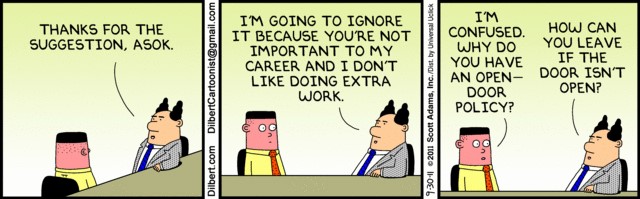
Lesson 11: “An Open-Door Policy doesn’t work if there is a jerk on the other side of the door”

The ever popular “Open Door Policy”. “My office is always open. I want to hear from you.” The ironic thing is that if a manager has to tell you his door is open it’s probably because the door is figuratively closed most of the time. In order to actually have an open-door policy, you have to mean it, and care about the importance of open communication with your associates.

dilbert-open-door

Spend time actually outside of your office. Walk around. Step into their office spaces from time to time. Ask questions. See what they are working on. And most importantly, be responsive to their requests. I’m not always as consistent as I need to be on the last one. I allow myself to get pulled into the inertia that is “managing up” or at least “managing the matrix!” Constant project meetings, task forces, communication routines, etc. take up an inordinate amount of time on most days, which means less and less time to focus on my associates’ needs. I find myself focusing completely on them in spurts. I convince myself that at least I do that, but the truth is, the best leaders make their employees feel like they are the most important thing in the day.

Lesson 12: “You are responsible for your own development”

A company, or a manager, cannot develop you. It is just not possible. Think about your own kids, or the kids you knew in school. Which ones excelled in their classes? Only the ones that had excellent teachers? Did the accomplished students get extra time with their teachers and they just poured their knowledge into them? Of course not. The great students were the ones that studied, or were able to make connections to the material in ways that allowed them to retain the knowledge and then apply it in homework and exams.

The students that didn’t do well either didn’t study or could simply not make the connection to the material. For me, once imaginary numbers became a thing, I lost connection to my math classes and started to struggle!

It’s the same in business. The people who excel are those that take it upon themselves to study and to make connections to the material. They learn through classroom training, by reading books and articles, and by spending time with others in the organization who can help them … mentors and successes in their areas of excellence. One of my favorite quotes is from George Bernard Shaw. I keep a plaque of it on my desk … (Side note – I only learned of the quotes’ origin in recent years, and it actually makes the quote even more poignant … Source: George Bernard Shaw, Mrs. Warren’s Profession, Vivie Warren in Act II)

  • “The people who get on in this world are the people who get up and look for the circumstances they want and if they can’t find them, make them.”

Management is responsible for providing tools and the environment for development. A manager’s role is to support and assist associates in their development plans. However, in the end, you are responsible for your own development!

Lesson 13: “Choose your next position with an eye to the one after that”

People often come to me at work to ask my opinion of a job opportunity they are considering. They want to know if I think it’s a good job for them to go for. I am very consistent in my next question.

  • What job is that position preparing you for in the future?

Too often that is not a question they have considered. Each position should be viewed as training for the next job. To figure out if a job is right for you, you need to have an idea of where you are heading in your career. Positions don’t have to be completely linear, as in within the same reporting structure. I do believe, however, that they should be complimentary. Each job should add skills to your portfolio to better prepare you for the next job on your path. I feel it’s a mistake to go for a job just because it sounds interesting, or exciting, if you don’t have an eye to the future. You might trade a short-term interest for a long-term career path.

Of course, the trick here is to have an idea of where you want to head in your career. Don’t feel pressure to know the exact position, but get comfortable with the type of work you want to do … Customer Facing, Sales, General Management, Functional Expertise, Marketing – Brand, Commercial or Partnership/Alliance. Figuring out the type of work you want to do will lead to the type of position you ultimately want to shoot for, and therefore clarify the path before you. Don’t worry about the next job until you clarify the longer-term goal. It will make your career decisions easier and more productive.

Lesson 14: “Effective Leadership means leading others to lead themselves”

Years ago, a young manager came to meet with me very concerned about her ability to manage one of her associates. “He’s better than I am now,” she said. “There’s nothing more I can teach him.” I remember coaching her that she was confusing leading and teaching. I couldn’t do her job as well as she did it. Why should she expect that she could do his job as well as he did it? How many great sports coaches can take the field and outperform their players?! Just because you, as a leader, cannot teach technical skills to your associates that they don’t already know does not mean you can’t be effective. Teams need direction, coaching, inspiration and effective questioning to lead to procedural improvements.

  • Managers direct, teach and control. Leaders build teams to lead themselves, by instilling belief, direction and conviction into the team members themselves.

I think the ability to create “leaders of self” is a critical skill for today’s organizational leaders to have. More and more, the people we manage are in different locations, scattered across the country or globe, often working isolated from home offices. If you, as a leader, cannot build the ability for your team to lead themselves, your team will fail. Modeling work ethic, learning to ask good questions, and getting creative in how to check in on associates without policing are among the soft skills needed for today’s leaders.

Lesson 15: “Learn to listen, and you’ll learn to love”

Have you ever heard the saying God gave you two ears and one mouth, so you should do twice as much listening as speaking? It may have come from James 1:19, “Wherefore, my beloved brethren, let every man be swift to hear, slow to speak, slow to wrath.”

Too often in business, we do not follow this approach. We use judgmental listening. We hear people talking and we are judging … from HOW they are saying things, to WHAT we would be saying if we were in their place. To be effective, leaders must use empathetic listening by trying to hear the message through the speakers’ ears, and see the message through the speakers’ eyes. There are some great books and articles about listening. Most address the bias that we all listen through. We listen, primarily, with the intent to respond. So, we immediately begin to craft our response. That’s why we drift off while we “listen” to people. We begin to think about how clever a response we will make or exactly how we’re going to zing the other person. “If I say this, they’ll really be impressed!” The author, David Augsburger, has a great quote:

  • “Being heard is so close to being loved that for the average person, they are almost indistinguishable.”

Think about the stereotypical used car salesman. He doesn’t care what kind of car you want, he’s got the car for you! If you don’t listen empathetically to your associates or peers, how do you know what kind of car they want?

Here endeth the lessons!

I hope you found them helpful, or at least thought provoking. What lessons have you learned along the way? Share them in comments below.